
Aluminium profile guide
Aluminium Profile Shutter for Kitchen and Wardrobe — Glass, Mirror and Frame Guide
What an aluminium profile shutter is, how it differs from a handle profile, and how to specify the glass, hinge, finish and weight.
The short answer
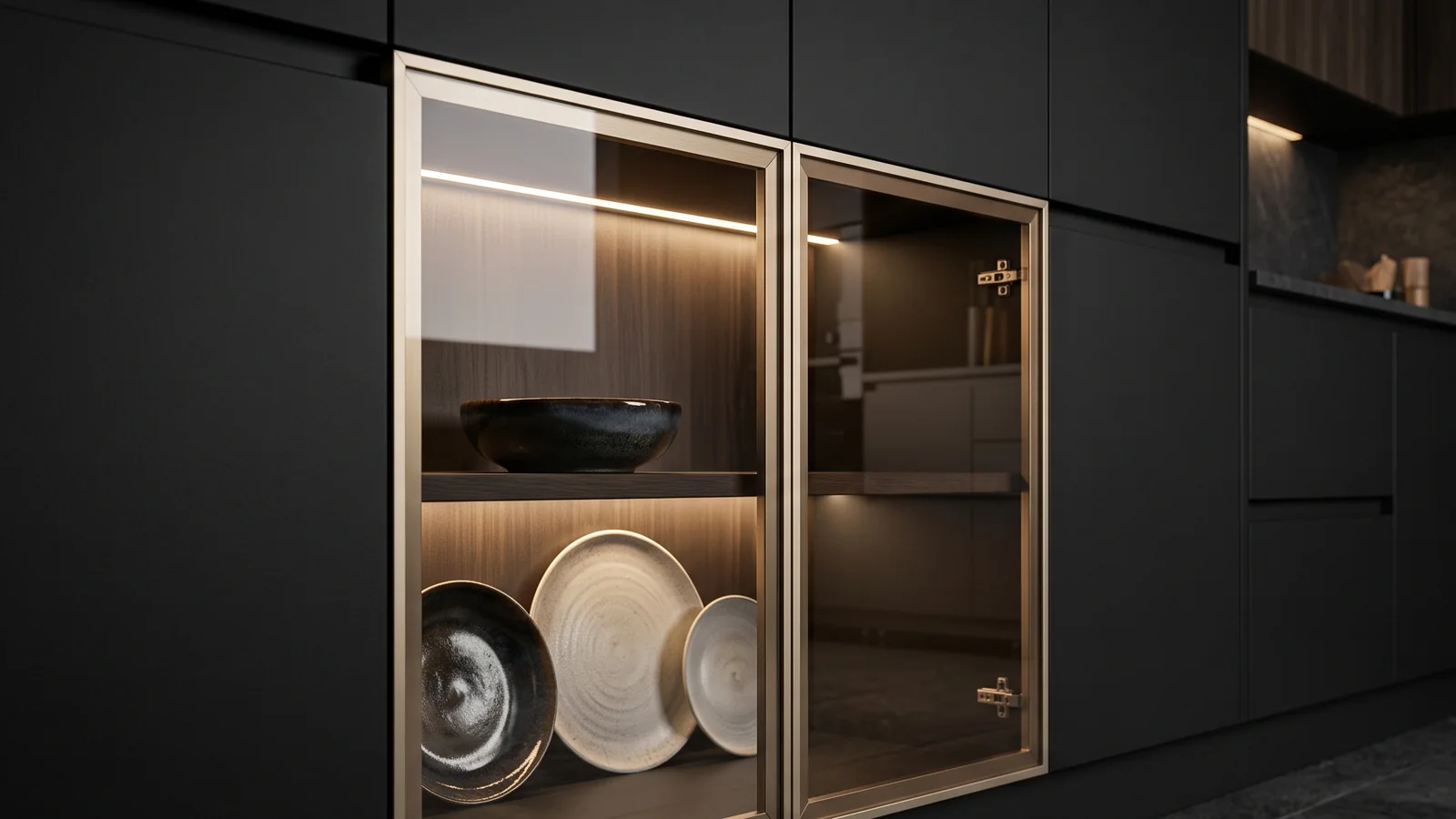
An aluminium profile shutter is a door whose aluminium frame holds a glass or mirror panel, mitred at the corners and joined with connectors. It suits display units, crockery cabinets, wardrobe mirror doors and glass wardrobe walls. Check glass thickness, door weight, hinge rating and finish before ordering. It is not the same product as a G-profile or gola handle profile.
Search for an aluminium profile shutter and you will find three different products under one name: a handle profile, a gola channel, and a glass or mirror door framed in aluminium. They are not interchangeable, and ordering the wrong one is an expensive mistake once the carcass is built.
This guide is about the third one, the aluminium profile shutter: what it is, where it works in a kitchen or wardrobe, how it compares with laminate, acrylic and frameless glass, how to calculate door weight and what to put on a specification before you order. It uses Mirano's published specifications for its aluminium profile and openable wardrobe ranges, with general industry guidance clearly labelled as such.
The basics
What is an aluminium profile shutter?
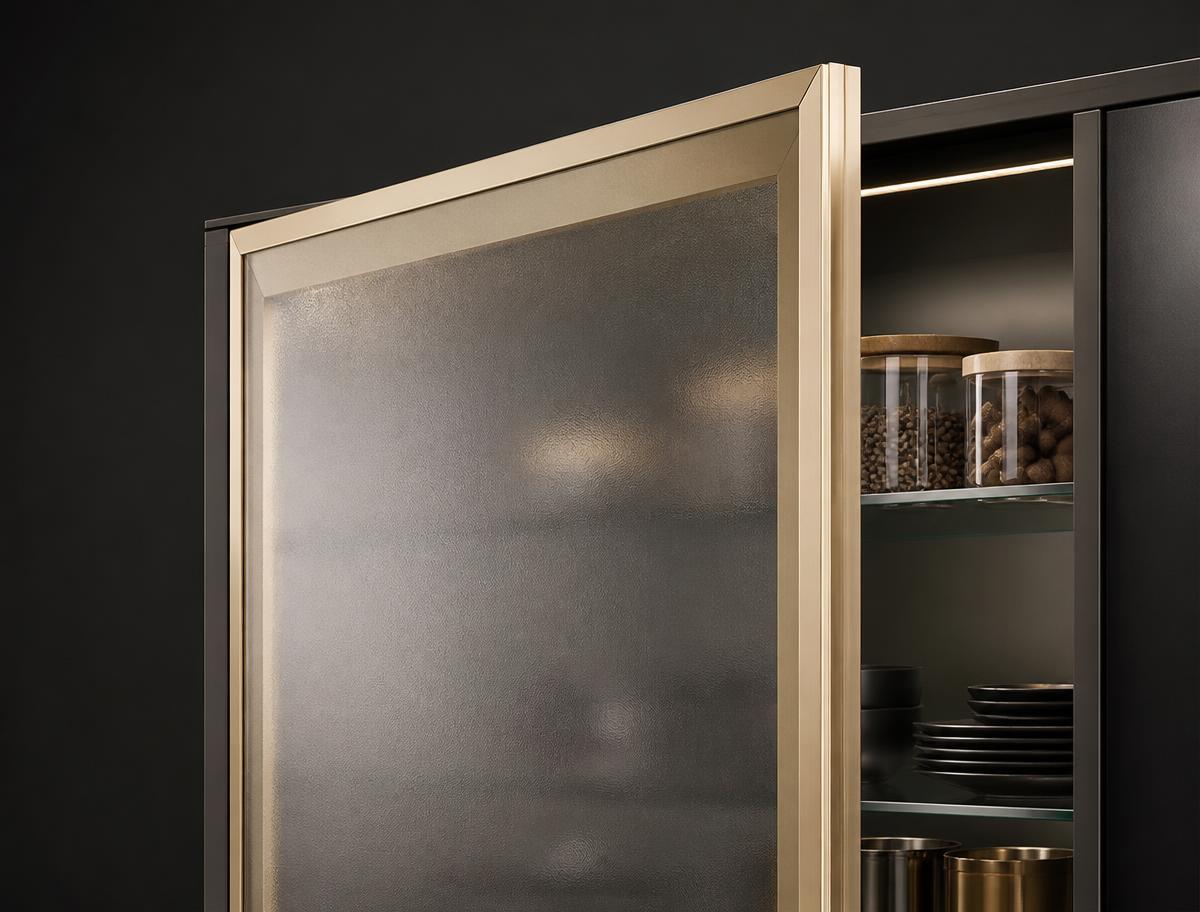
An aluminium profile shutter is a cabinet or wardrobe door made from an extruded aluminium frame that holds a glass or mirror panel. The frame sections are cut at 45 degrees, joined with corner connectors and fitted around the panel, so the aluminium forms a slim, rigid border on all four sides.
The result is a door that looks light, shows off what is behind it and is much harder to chip or swell than a laminate edge. It is specified for display units, crockery cabinets, wardrobe mirror doors, glass wardrobe walls and boutique or retail display joinery.
Mirano's aluminium profile range covers three related products, and it helps to keep them apart:
| Product | What it is | Where it is fixed | Typical use |
|---|---|---|---|
| G-profile and C-profile handles | A grip channel along the shutter edge | Shutter edge | Handleless kitchen base, wall and tall units |
| Recessed gola profile | A shadow-line grip channel | Carcass, below or beside the shutter | Fully handleless, minimalist kitchen face |
| Aluminium profile shutter | A frame that holds a glass or mirror panel | Forms the shutter itself | Display units, crockery cabinets, mirror and glass wardrobe doors |
If your goal is a handleless solid door, see our guide to handleless kitchen options and the aluminium profiles range. The rest of this article is about framed glass and mirror doors.
Construction
How an aluminium frame shutter is built
Four parts decide how a framed door looks and lasts.
- The frame section: An extruded aluminium profile. Extrusion tolerance and wall thickness decide whether the door stays square and flat, and whether corners close without a visible step.
- The corner connectors: Mitred corners are held together with connectors. Clean 45 degree joints depend as much on connector quality as on the profile itself.
- The panel: Clear, bronzed or mirror glass in most systems, and wood in some frame variants. Glass is normally toughened for doors.
- The fixing method: Pasting mounts the panel on the surface of the frame; insert recesses it inside the frame channel. Mirano's Air Glass Structure 30kg is available in both.
What you cannot see matters most. Ask for the extrusion tolerance, the wall thickness and how the finish is bonded to the metal. A profile made to a tight tolerance sits flush and mitres cleanly; one that is slightly out of true shows a gap at the corners as soon as it is fitted. Anodised layers bond into the metal, while powder coats sit on top of it, and the difference shows first in high-contact zones.
Material comparison
Aluminium profile shutter vs laminate, acrylic, PU and frameless glass
There is no universally best shutter. The right choice depends on what the door has to do. The table below is general industry guidance rather than a Mirano specification, so treat the ratings as a starting point for your own project.
| Factor | Aluminium profile with glass or mirror | Laminate or acrylic solid shutter | Painted or PU solid shutter | Frameless glass |
|---|---|---|---|---|
| Look | Slim metal border, see-through or reflective | Solid, uniform surface | Smooth, seamless colour | Pure glass, no border |
| Shows contents | Yes, clear or bronzed glass | No | No | Yes |
| Edge durability | High, metal border protects the panel edge | Depends on edge banding | Edges can chip | Exposed glass edges need care |
| Moisture behaviour | Frame does not swell or rust | Board edges can swell if sealed poorly | Depends on finish quality | Not affected |
| Best for | Display units, crockery cabinets, mirror and glass wardrobes | Everyday kitchen base and wall units | Premium painted kitchen fronts | Showcase pieces |
| Watch out for | Door weight and hinge choice | Visible edge lines | Repair cost | Fixing and safety detailing |
For most Indian homes the practical split is simple: solid shutters for everyday storage, framed glass or mirror where you want display, light or a larger-feeling room.
Applications
Where aluminium profile shutters work best
In the kitchen. Framed glass belongs on display units, crockery cabinets and tall units where you want to show glassware or ceramics. Add warm internal lighting and the cabinet becomes a feature. Keep it away from heavy-use, grease-prone zones such as directly beside the hob, where a solid shutter is easier to wipe.
In the wardrobe. A mirror door removes the need for a separate dressing mirror and makes a bedroom feel larger. A glass or bronzed-glass door lets a dressing area read as a display. Mirano's Filo openable frame accepts glass, bronzed glass and mirror fronts, in variants listed as Filo 50, Filo 20, Filo Wood and Filo Slide.
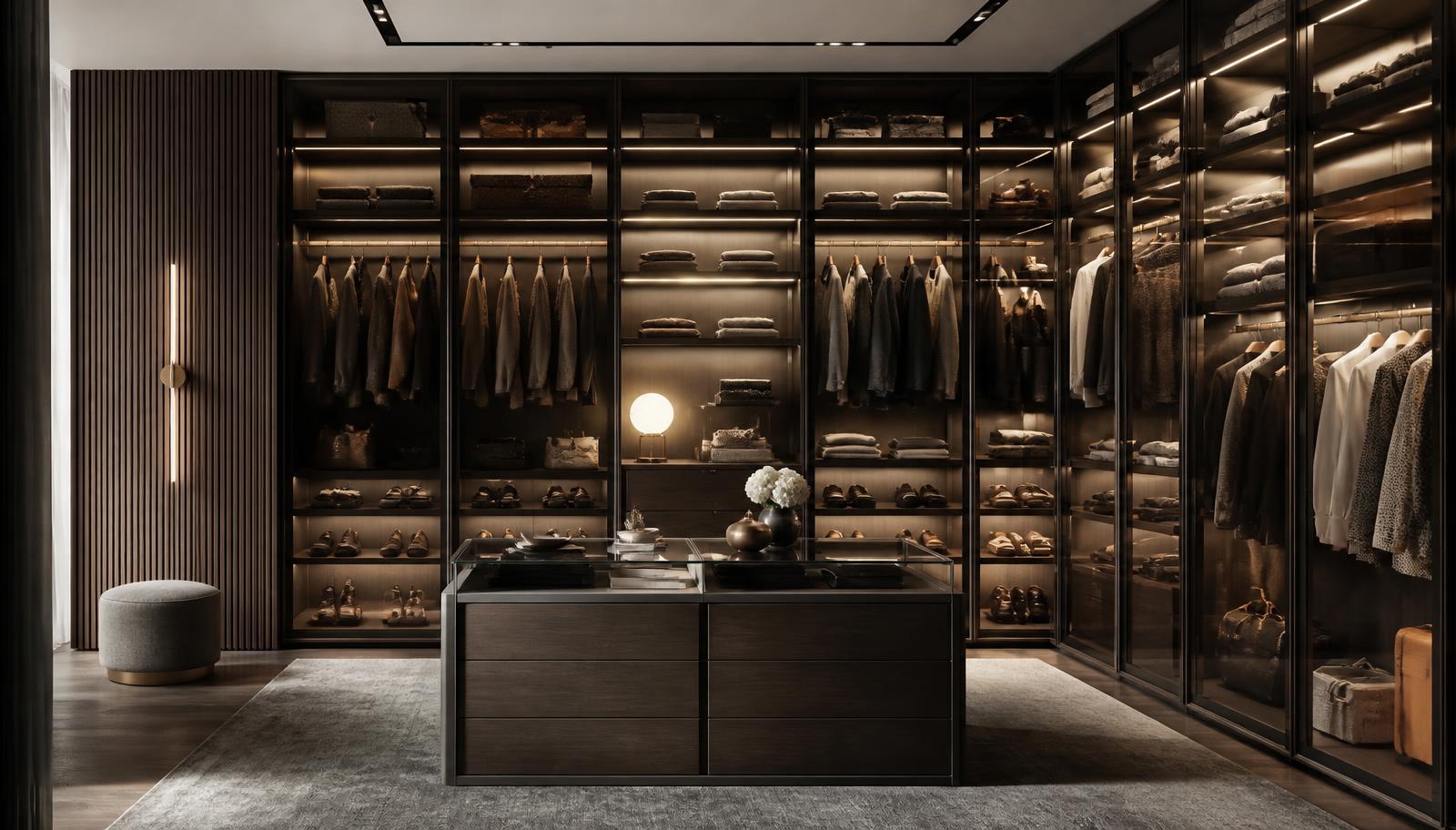
In walk-in closets. Mirano's Air Glass Structure 30kg is engineered for four-sided glass wardrobe walls, where the frame, shelves and doors run on the same slim aluminium profile language so the structure reads as one piece. Our guide to walk-in wardrobe fittings covers how these walls are planned.
In retail and boutique joinery. The same frame and glass approach is used for display cabinetry, which is a common brief for architects.
Glass and panels
Choosing the glass, mirror or panel
| Panel | Where it suits | Points to check |
|---|---|---|
| Clear glass | Display and crockery units, glass wardrobe walls | Interior must look tidy; consider internal lighting |
| Bronzed glass | Wardrobes and dressing units where you want softer visibility | Shows less of the contents than clear glass |
| Mirror | Wardrobe doors, dressing zones, small rooms | Mirror weight and edge safety; confirm backing or safety film with your supplier |
| Wood front | Mixed-material wardrobe runs | Filo Wood is the wood-front variant in Mirano's openable range |
Thickness is the detail that is most often missed. Mirano's Air Glass Structure 30kg is designed for 4mm glass only. The wider openable range supports 4mm and 6mm toughened glass, bronzed glass, mirror and veneered wood fronts. Do not assume a profile that works for one thickness will hold another; the channel, the hinge and the weight rating all change.
Door weight
How to check door weight before you choose hinges
Door weight is the number that decides whether an aluminium frame door will hang true for years. The rule of thumb for glass is about 2.5 kg per square metre for every millimetre of thickness, so 4mm glass is roughly 10 kg per square metre and 6mm glass roughly 15 kg per square metre. The frame adds to that, and the figure for a given profile should be confirmed with Mirano.
A worked example, using Mirano's published numbers: a door 600mm wide and 2,000mm high has an area of 1.2 square metres. In 4mm glass that is roughly 12 kg of glass before the frame. Mirano's Air Glass Structure 30kg is rated for up to 30kg per door and for doors up to 600mm wide and 2,950mm high, so this door sits comfortably inside the rating. A 6mm door of the same size would carry roughly 18 kg of glass, and the margin would be smaller.
Mirano's sliding wardrobe guidance takes a more conservative view for glass-faced doors, using 20 to 25 kg per square metre as a planning figure, then adding 10 percent and specifying a system rated above the result. If you are specifying a sliding glass door rather than a hinged one, use that approach. See the sliding vs openable wardrobe guide for the full method.
Hardware
Hinges, opening angles and soft close
A framed glass door is only as good as the hinge behind it. Mirano's openable wardrobe range uses three-way adjustable hinges that allow vertical, horizontal and depth adjustment, so an installer can bring a multi-door run to a flush, even gap. That matters most on handleless and minimalist fronts, where an uneven line is obvious.
Opening angles vary by system. The Air Glass Structure 30kg opens to a maximum of 105 degrees. Selected Allinea hinges give opening options up to 270 degrees where wider access is needed. Integrated soft-close dampers absorb the door's momentum so glass-on-frame contact is controlled over thousands of cycles.
For solid doors in the same wardrobe or kitchen, see our guide to cabinet hinge types and the soft close hinges range.
Finishes
Frame finishes: matte black, champagne gold, silver and rose gold
Mirano's aluminium profile range is available in matte black, champagne gold, brushed or anodised silver and rose gold, with anodising and powder-coat options depending on the finish and application. The shutter frames come in the same finish range as the handle profiles, so a kitchen or wardrobe run can be matched end to end.
As a guide: matte black gives a high-contrast, contemporary frame against light shutters; champagne gold adds a warm premium accent to dark or neutral cabinetry; silver is the quiet, practical choice; rose gold suits softer, warmer palettes. Anodising is generally specified where the frame sees heavier contact because it forms a harder, scratch-resistant layer, at a marginally higher cost.
Design details
Design details that make a framed glass door look right
A framed door is a small piece of architecture, and the details decide whether it reads as premium.
Frame width. A slim frame feels light and modern; a wider frame feels more traditional and hides more of the panel edge. Mirano's Air Glass Structure uses side profiles in 45mm and 70mm widths, which gives a practical example of the two ends of the range.
Interior. Clear glass shows everything behind it. In a kitchen display unit that means styling the shelves, adding internal light and keeping the back panel finished. In a wardrobe it means deciding whether the client is happy for the interior to be seen. Bronzed glass and mirror are the quieter choices.
Lighting. The Air Glass Structure 30kg system includes an LED shelf profile among its accessories, so shelf lighting can be integrated into the same aluminium language. For the wider lighting decision, see our guides to silicone, PC and PMMA LED profiles and LED profile lights for wardrobes and kitchens.
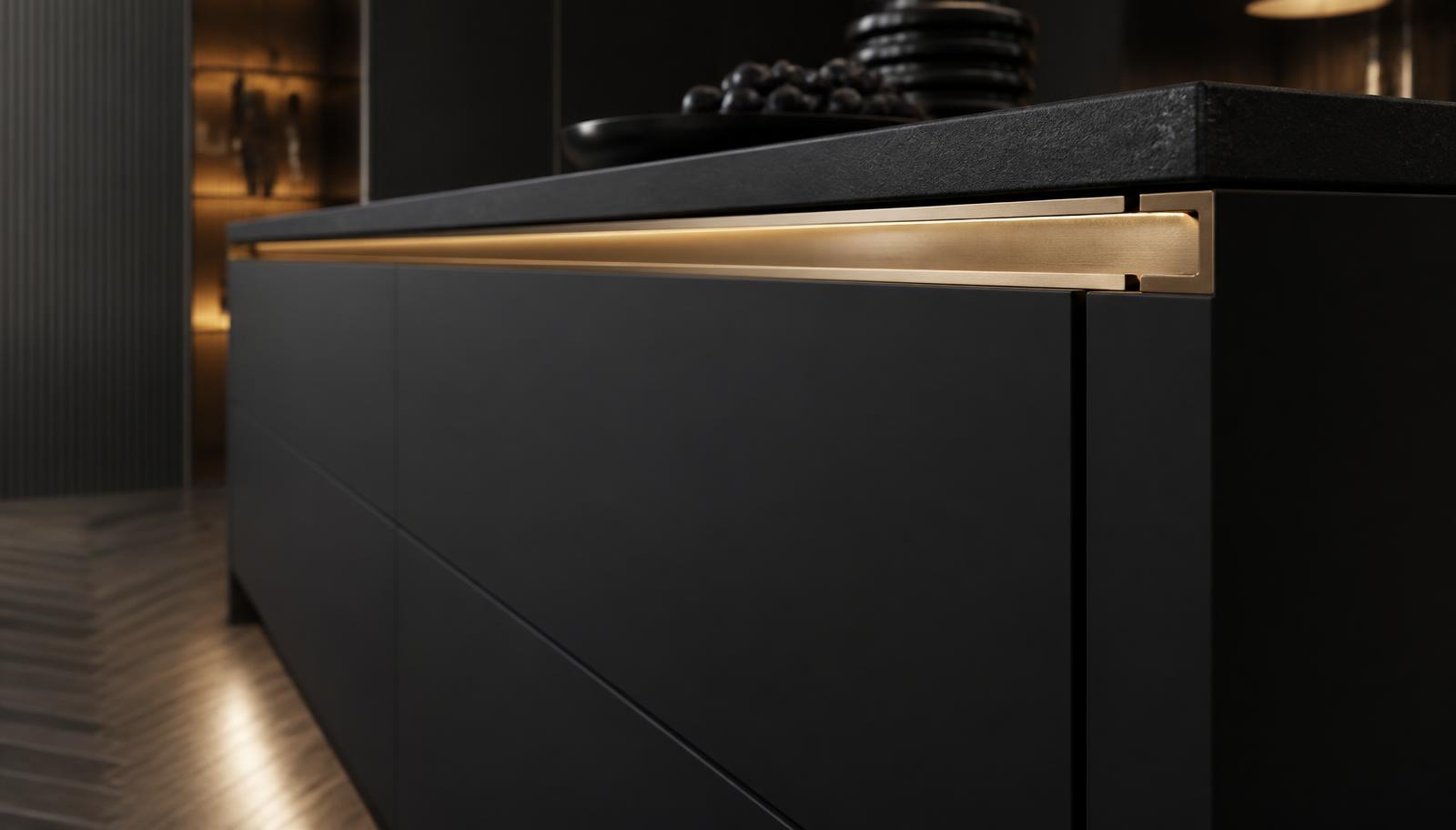
Handle detail. Framed doors can take a handle profile in the same finish, or a standard handle from the handles and knobs range. Matching the finish across frame and handle is what makes the run look designed rather than assembled.
Installation
Installation and alignment checklist
- Check the carcass first: Frames and glass doors expose every error in the cabinet: out-of-square openings, uneven reveals and warped panels.
- Use the hinge adjustment: Three-way hinges allow vertical, horizontal and depth adjustment. Set the gaps on the first door and repeat across the run.
- Handle glass and mirror carefully: Edges chip easily on site. Unpack at the point of use and keep the panels upright.
- Protect the finish: Keep the frame's protective film on until the end of the fit-out, particularly on anodised and powder-coated finishes.
- Check the closed position: Doors should settle shut under the soft-close damper without touching the frame or each other.
Care
Cleaning and long-term care
Aluminium frames need little care. Wipe them with a soft damp cloth and a mild detergent, and avoid abrasive pads or strong solvents that can damage a powder-coated or anodised surface. Glass and mirror can be cleaned with a standard glass cleaner applied to the cloth rather than sprayed on the door, which keeps liquid out of the frame and the hinge area.
This is general care guidance, not a Mirano specification. Where a project has a specific finish or coating, confirm the recommended cleaning products with the supplier.
Specification
What to put on a specification before you order
- Door size and quantity: Finished width, height and number of doors per cabinet. Frames are cut and mitred to size.
- Panel type and thickness: Clear, bronzed or mirror, and the exact thickness, confirmed against the profile.
- Fixing method: Pasting or insert, for systems that offer both.
- Finish and zone: Matte black, champagne gold, silver or rose gold, and whether anodising is needed for the zone.
- Hinge and opening angle: Hinge type, opening angle and soft-close requirement.
- Accessories: Side profiles, shelf and LED shelf profiles, handle profile and corner connectors where the system provides them.
- Batch consistency: For OEM and project orders, ask for batch documentation so colour and tolerance stay consistent across the run.
- Lead time: Plan bulk and OEM orders against production and dispatch lead times rather than retail stock.
Common mistakes
Mistakes to avoid
- Ordering without checking door weight: This is the most common hardware error on residential projects. Calculate it first.
- Mixing up handle profiles and shutter profiles: They are different products. Specify the shutter frame explicitly.
- Ignoring glass thickness: Check the channel and hinge rating, not just the glass.
- Choosing the finish last: Decide the finish at design stage so handles, frames and hardware match.
- Skipping the sample: Check tolerance, mitre quality and finish on a real sample before a bulk order.
Decision framework
How to choose in four steps
| Step | Question | Typical answer |
|---|---|---|
| 1 | What must the door do? | Display, reflect, or simply close storage |
| 2 | How heavy will it be? | Calculate glass thickness and area, then confirm against the system rating |
| 3 | Hinged or sliding? | Hinged gives full access; sliding saves floor space. See the sliding vs hinged guide. |
| 4 | Which finish suits the zone? | Anodised for high contact; powder-coated where colour matters most |
If you are specifying for a project or OEM line, our team can help match profile, glass, hinge and finish before the carcass is built. Use the quote form and share door sizes, glass type and finish.
Clear answers
Frequently asked questions
What is an aluminium profile shutter?
An aluminium profile shutter is a door made from an extruded aluminium frame, mitred at the corners and joined with connectors, that holds a glass or mirror panel. It is used for display units, crockery cabinets, wardrobe mirror doors and glass wardrobe walls.
What is the difference between an aluminium profile shutter and an aluminium profile handle?
A profile handle (G-profile or C-profile) is a grip fixed along the edge of a solid shutter. A profile shutter is the shutter itself: the aluminium frames a glass or mirror panel on all four sides. Both come from the same extrusion technology and can share the same finish range, so a run stays visually consistent.
Which glass thickness works with an aluminium profile wardrobe shutter?
It depends on the system. Mirano's Air Glass Structure 30kg is designed for 4mm glass, while the Filo openable frame range accepts glass, bronzed glass and mirror fronts, and the openable range generally supports 4mm and 6mm toughened glass. Always confirm the glass thickness against the specific profile.
How much weight can an aluminium frame glass door carry?
Mirano's Air Glass Structure 30kg system is rated for 30kg per door on its air hinge, for 4mm glass panels up to 600mm wide and 2950mm high. Door weight depends on glass thickness, door size and frame, so calculate it before choosing hardware.
Is an aluminium profile shutter suitable for a modular kitchen?
Yes, mainly for display units, crockery cabinets and glass-fronted wall units, where the frame gives a slim, durable edge around the glass. For solid base-unit fronts, a handleless profile or a standard laminate or acrylic shutter is more usual.
Which finish should I choose: anodised or powder-coated?
Anodised finishes form a harder, more scratch-resistant surface layer and are the better choice where the frame sees frequent contact. Powder coating sits on top of the metal and offers a wider colour choice. Mirano lists matte black, champagne gold, brushed or anodised silver and rose gold, with anodising and powder-coat options depending on finish and application.
What is the difference between pasting and insert glass fixing?
Pasting mounts the glass on the surface of the frame. Insert fixing recesses the glass inside the frame channel. Mirano's Air Glass Structure 30kg is available in both configurations.
Can aluminium profile shutters be made to custom sizes?
Yes. Filo's aluminium frame profiles can be made to measure beyond standard sizes and Air Glass Structure profiles can be cut to suit specific door dimensions, which is standard practice for OEM and architect-specified projects.
Does an aluminium frame shutter suit humid Indian conditions?
Aluminium does not rust, which makes it a sound choice for humid and coastal homes. The finish matters more than the metal: anodised surfaces and good powder-coat bonding hold up better over time. Hinges and hardware should be chosen for the same conditions.
Can I add lighting to a glass aluminium wardrobe?
Yes. The Air Glass Structure 30kg system includes an LED shelf profile among its accessories, alongside side profiles (45mm and 70mm), a support profile, a shelf profile, a handle profile and corner connectors.
Specify with confidence
Specify aluminium profile shutters with confidence
Share door sizes, glass type and finish, and our team will help match the profile, hinges and accessories.