
Corner solutions guide
Kitchen Corner Cabinet Solutions — Magic Corner vs Lazy Susan vs Pull-Out
How magic corner, lazy susan, swing-out and blind corner pull-out systems compare, and how to choose for an L-shaped or U-shaped kitchen.
The short answer
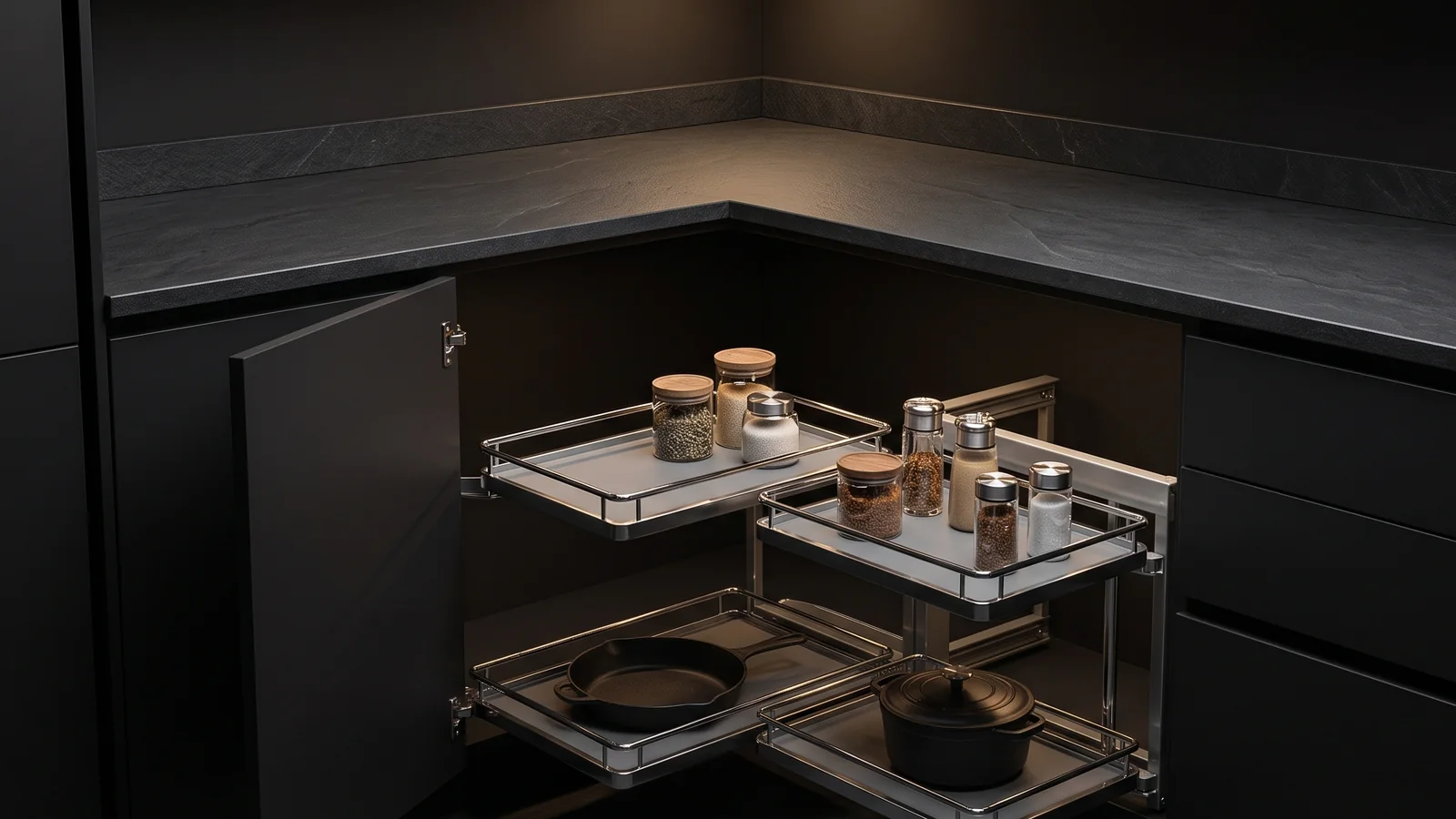
The main kitchen corner cabinet solutions are the magic corner (a two-shelf system that extends when the door opens), the lazy susan or carousel (rotating shelves), the swing-out unit (kidney-shaped shelves for cabinets over 600mm deep) and the blind corner pull-out. Choose by the door opening, the cabinet depth and the load, and plan the cabinet around the unit.
The corner cabinet is where kitchen storage goes to die. A fixed shelf in a blind corner means the front few inches are useful and everything behind them is lost until someone kneels, reaches in and finds a pan they bought two years ago.
This guide compares the main corner solutions: magic corner, lazy susan and carousel, swing-out and blind corner pull-out. It explains how each works, which layouts they suit and what to confirm before the carcass is cut. Figures marked as Mirano's come from its published accessories guidance; other planning points are general guidance and are labelled.
The problem
Why the corner is the hardest cabinet to plan
Corner cabinets, in Mirano's words, are the most commonly wasted space in any kitchen layout. The reasons are geometric. In an L-shaped kitchen the two runs of base cabinets meet at a right angle, so the cabinet at the corner has a door on one face and a deep, blind space behind the adjacent run.
Corner solutions recover that space by bringing stored items forward to the cabinet opening, so nobody has to reach into a blind corner. The right choice depends on three things: the shape of the corner, the width of the door opening and what you want to store.
The options
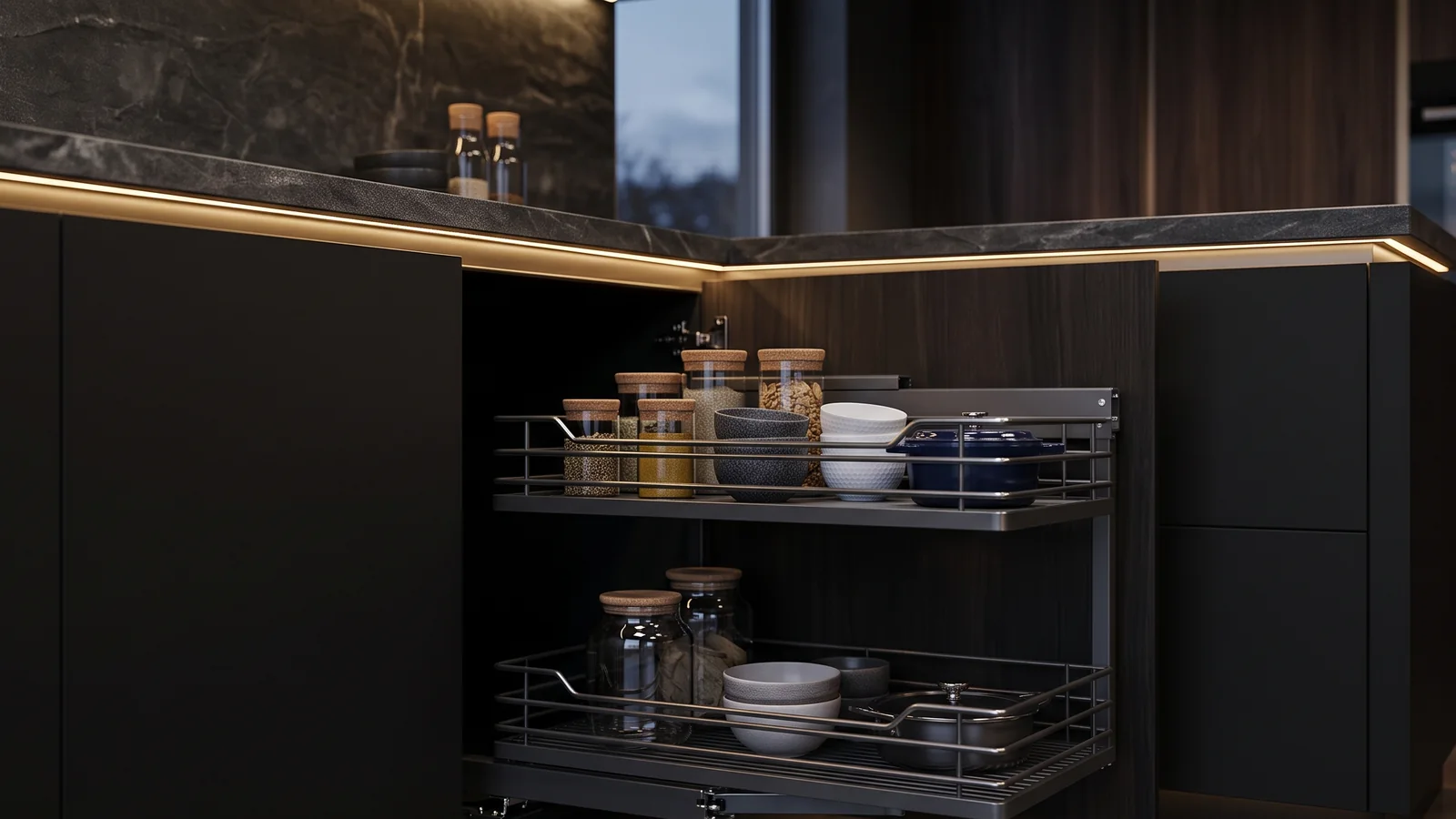
The four main corner solutions
| Solution | How it works | Best for | Watch out for |
|---|---|---|---|
| Magic corner | Two-shelf system that extends outward when the door opens | L-shaped and U-shaped kitchens, narrower door openings | Needs the right cabinet width, hand and door opening |
| Lazy susan (carousel) | Rotating circular or kidney-shaped shelves | Blind corners and full-round corner cabinets where the door opens wide | Round shelves waste the square corners of the cabinet |
| Swing-out corner unit | Kidney-shaped shelves that swing out | Cabinets deeper than 600mm | Needs depth; not for shallow cabinets |
| Blind corner pull-out | Baskets or shelves slide out on runners from a blind corner | Blind corners where the dead space behind the adjacent run is the problem | Needs planning of the adjacent cabinet and clearance |
The first three descriptions follow Mirano's published accessories guidance. For a closer look at how a magic corner works, see our magic corner kitchen unit page.
Magic corner
Magic corner: when the door opening is narrow
A magic corner is a pull-out storage system for a blind corner base cabinet. When the door opens, the front baskets swing out and the rear baskets slide forward, so what was stored at the back comes to the opening instead of staying out of reach. The two layers present together and glide back when you push the door shut.
It is the standard answer for L-shaped and U-shaped kitchens, because it works through a narrower door than a carousel needs. Mirano's guidance recommends a minimum load capacity of 30kg total for a magic corner unit. Heavy items such as pressure cookers and cast-iron cookware belong on the lowest baskets.
- Handed units: Magic corner units are made left or right opening. The wrong hand will not fit the opening, so decide the side from the layout before ordering.
- Basket material: Glass baskets give a solid base and a premium look but add weight. Wire baskets are lighter and let air and light through.
- Soft close: Check whether the unit includes soft-close and the door fittings.
Lazy susan
Lazy susan and carousel: when the door opens wide
A lazy susan is a rotating circular shelf system. Items are brought round to the opening by turning the shelf. Mirano recommends it for blind-corner and full-round corner cabinets. It works well where the door can open wide, because the shelf has to be reached from the front as it rotates.
The geometry has a cost. Round shelves leave the square corners of the cabinet unused, so a carousel holds less than a well-fitted square unit in the same cabinet. It also stores tall bottles and awkward items well, because nothing gets lost behind a front rail.
Swing-out
Swing-out corner unit: when the cabinet is deep
A swing-out corner unit uses kidney-shaped shelves that swing out of the cabinet. Mirano suggests it for cabinets above 600mm depth. In a shallow cabinet it has no room to move; in a deep one it brings the whole shelf to the front and makes the full depth reachable.
By layout
Which solution suits which kitchen layout
| Kitchen layout | Corner solution to consider | Other accessories Mirano lists |
|---|---|---|
| Straight (I-shape) | No blind corner, so a corner solution is not needed | Pull-out baskets, drawer systems, pantry tall unit, waste bin |
| L-shape | Magic corner unit | Pull-out baskets, drawer slides, bottle pull-outs |
| U-shape | Two magic corners and a lazy susan | Pantry pull-out, full drawer suite |
| Parallel | No blind corner | Pull-out baskets both sides, soft-close hinges, tandem boxes |
| Island | No blind corner | Drawer systems, cutlery trays, integrated waste bin, lift-ups for overhead units |
The layout guidance is from Mirano's modular kitchen accessories guide. If you are planning the drawers and pull-outs around the corner, our 15-fitting hardware checklist and pull-out systems guide cover the rest of the kitchen.
Measuring
What to measure before you order
- Clear opening width: The width the door actually gives you, not the nominal cabinet width. Mirano flags this as a critical check.
- Hinge-side clearance: Hinges and door thickness reduce the usable opening. Confirm the clearance before ordering.
- Internal width and depth: Confirm against the datasheet before the carcass is cut.
- Hand: Left or right opening decided from the layout.
- Rated load: Per basket and per set, matched to what will be stored.
- Finish and fittings: Soft close, door fittings and basket finish.
Ask for a datasheet and a dimensioned drawing, and share your cabinet width, hand and quantity through the quote form so we can confirm the current options.
Storage
What to store where
| Item | Best location | Reason |
|---|---|---|
| Heavy pots, pressure cookers, cast iron | Lowest basket of a magic corner | Keeps weight low and within the rated load |
| Everyday cookware | Front baskets, nearest the opening | Reached daily, so keep it close |
| Appliances used occasionally | Rear or upper baskets | Brought forward when needed |
| Bottles and tall items | Lazy susan shelves | Rotating shelves keep tall items from getting lost |
| Lids and trays | Swing-out shelves | Deep shelves keep flat items visible |
The best corner solution is the one that matches what the household actually stores, not the one that looks best in a catalogue. Ask the client what lives in the corner today.
Worked example
A worked example: a compact L-shaped kitchen
An L-shaped kitchen has one corner base cabinet and a narrow door opening. The client cooks daily and has several heavy pans. A lazy susan would need a wide opening and would waste the square corners of the cabinet, so the better choice is a magic corner with a rated load matched to the cookware.
The designer confirms the clear opening width and hinge-side clearance, decides the hand from the layout, specifies the soft-close version and keeps the heaviest pans on the lowest baskets. In a U-shaped kitchen the same logic applies twice: a magic corner at one corner and a lazy susan at the other, if the second corner has a wider opening.
The key is the order of decisions: layout, then door opening, then the unit, then the cabinet. Reversing that order is how teams end up with a unit that does not fit.
Existing kitchens
Retrofitting a corner solution
- Check the opening: Measure the clear opening, not the cabinet width.
- Check the hinges: The existing door and hinges must work with the unit, and some units need specific door fittings.
- Check the depth and height: The unit must fit inside the cabinet with the baskets fully extended.
- Check the counter above: Under-counter clearance and the floor of the cabinet must take the load.
- Decide whether to rebuild: If the cabinet needs major changes, replace it rather than forcing the unit in.
Common mistakes
Mistakes to avoid
- Choosing the unit before the cabinet: Corner units are sized to the cabinet. Plan the cabinet around the unit.
- Ignoring the door opening: A unit that needs a wide opening does not suit a narrow one.
- Overloading the baskets: Check the rated load and place heavy items low.
- Fitting a carousel in a square corner: Round shelves waste the corners. Consider a square or kidney-shaped unit instead.
- Forgetting the hand: A left-hand unit does not fit a right-hand opening.
Other approaches
Other ways to plan a corner, and why they sometimes win
A pull-out is not the only way to deal with a corner. Three alternatives are worth considering at the design stage.
| Approach | How it works | When it makes sense |
|---|---|---|
| Diagonal or angled corner cabinet | The corner is cut at an angle so the door faces into the room | Small kitchens where the angled door is acceptable and the cabinet is simple |
| Open or display corner | A shelf or open unit turns the corner into a feature | When storage matters less than the look |
| Appliance or utility corner | The corner is used for a built-in appliance or a dedicated tall unit | When a large appliance has no better place |
| Drawer-based corner | The corners are made from drawers on both runs, avoiding a blind corner | Handleless and drawer-led kitchens where the corner is planned out |
These approaches are general design options, not Mirano products. If the corner is used rarely, one of them can be the better value than a full pull-out. If it holds daily cookware, a proper corner solution usually repays the extra cost within a few months of use.
Cost drivers
What drives the cost of a corner solution
- Mechanism type: Magic corners and swing-out units are more complex than a fixed shelf or a basic carousel.
- Basket material: Glass baskets cost more than wire; solid bases weigh more.
- Soft close and door linkage: Damped movement and door-linked mechanisms add cost and improve daily use.
- Cabinet size and hand: Non-standard cabinet widths and left or right versions can affect availability.
- Finish: Chrome, anthracite and other finishes vary by range.
- Quantity: Project and OEM quantities are quoted differently from single units.
Mirano does not publish prices for corner solutions on this page. Share your cabinet width, hand and quantity through the quote form for current options and pricing.
Decision framework
How to choose in four questions
| Question | If yes | If no |
|---|---|---|
| Is the door opening narrow? | Magic corner | Lazy susan or carousel |
| Is the cabinet deeper than 600mm? | Consider a swing-out unit | Magic corner or carousel |
| Will heavy cookware live here? | Check the rated load; place heavy items on the lowest baskets | Lighter units are fine |
| Is the corner used daily? | Invest in a full corner solution | A simpler shelf may be enough |
Our team can help match a corner solution to your cabinet drawings. See the pull out systems range and the kitchen fittings overview.
Clear answers
Frequently asked questions
What is the best solution for a kitchen corner cabinet?
There is no single best option. A magic corner suits L-shaped and U-shaped kitchens with a narrow door opening, a lazy susan suits blind and full-round corners where the door opens wide, and a swing-out unit suits cabinets deeper than 600mm. Choose by cabinet geometry first, then by what you store.
What is the difference between a magic corner and a lazy susan?
A magic corner is a two-shelf system that extends outward when the door opens, bringing back storage to the front. A lazy susan, or carousel, is a rotating circular shelf system that brings items round to the opening. Magic corners suit narrower openings; lazy susans suit corners where the door opens wide.
What is a blind corner pull-out?
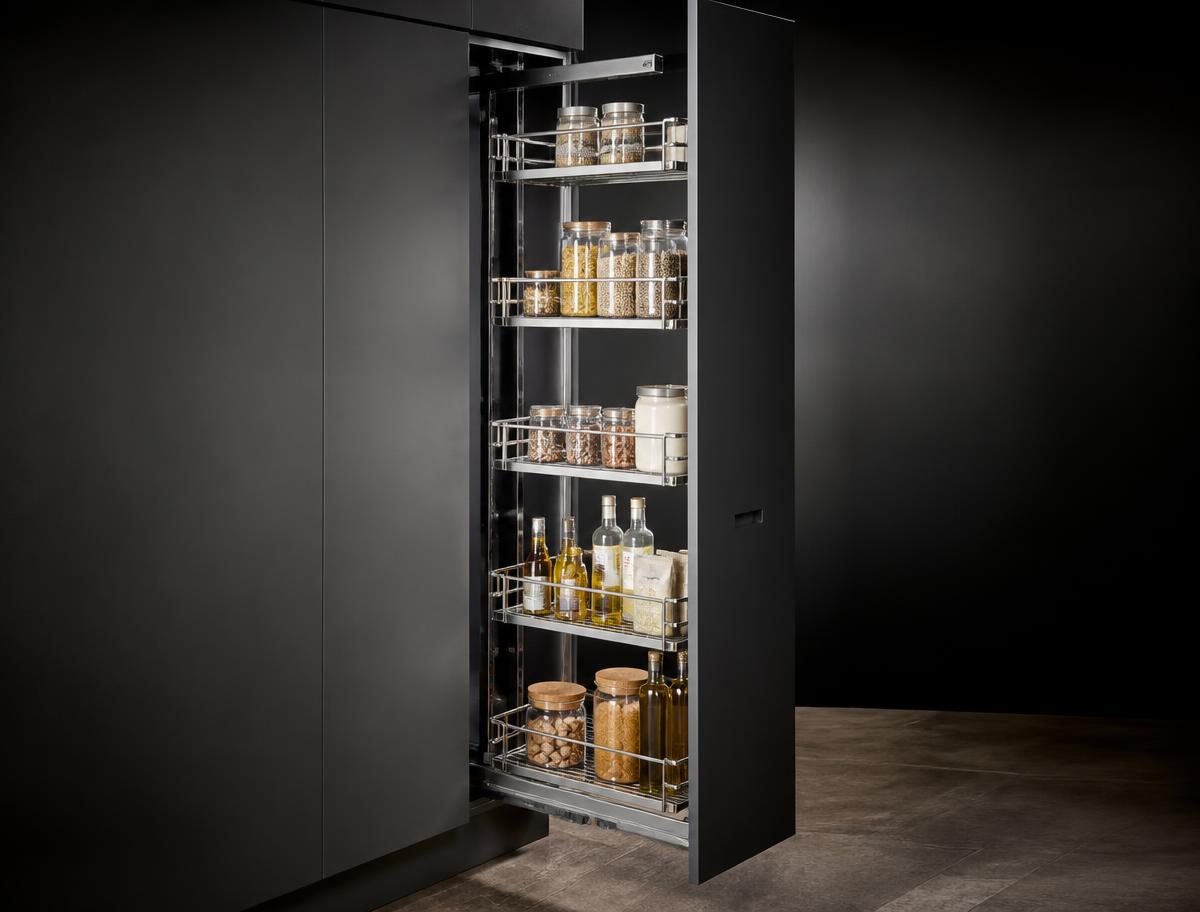
A blind corner pull-out is a set of baskets or shelves on runners that slides out of a blind corner cabinet, so the dead space behind the adjacent cabinet becomes reachable. It is the general family of solutions that magic corner units belong to.
How much weight can a magic corner unit carry?
Mirano's accessories guide gives a recommended minimum load capacity of 30kg total for a magic corner unit. Individual models vary, so check the rated load per basket and per set, and keep heavy cookware on the lowest baskets.
What size corner cabinet do I need?
Corner solutions are made for specific cabinet widths and door openings, so the cabinet has to be planned around the unit. Confirm the cabinet clear opening width and the hinge-side clearance before ordering; dimensional mismatches are the most common installation error on corner units.
Which corner solution suits an L-shaped kitchen?
Mirano's layout guidance points to a magic corner unit, pull-out baskets, drawer slides and bottle pull-outs for an L-shaped kitchen.
Which corner solution suits a U-shaped kitchen?
A U-shaped kitchen has two corners. Mirano's layout guidance lists two magic corners, a pantry pull-out, a lazy susan and a full drawer suite for a U-shape.
Are corner solutions worth the extra cost over a fixed shelf?
In a blind corner a fixed shelf wastes most of the cabinet. A corner solution costs more and needs careful planning, but it recovers space you would otherwise lose. For a rarely used corner, a simpler option can be enough.
Can I retrofit a corner solution into an existing kitchen?
Sometimes. The corner cabinet needs the right internal width, depth and door opening, and the existing door and hinges must work with the unit. It is usually easier to plan it at the design stage.
Does Mirano supply corner solutions?
Yes. Mirano lists a magic corner kitchen unit and corner pull-out systems in its kitchen fittings range, and supplies OEMs, designers, architects and dealers across India. Send your cabinet width, hand and quantity through the quote form.
Continue your research
Related ranges and resources
Specify with confidence
Specify corner solutions with confidence
Share your cabinet width, hand and quantity, and our team will confirm the current corner options.