
01
1. Check the board
Confirm shutter board thickness against the profile's compatible range before cutting lengths.
Slim extruded aluminium grip profiles that replace surface handles on shutters and drawer fronts — for OEMs, architects and interior designers across India.
A G profile handle is an aluminium section fixed along the top edge of a shutter or drawer front, leaving a slim groove for your fingers instead of a separate handle. It gives a kitchen or wardrobe the handleless look without the carcass changes a gola system needs, and it caps the raw board edge at the same time.
A G profile handle is an extruded aluminium section, G-shaped or C-shaped in cross-section, fixed to the top edge of a shutter or drawer front. The profile becomes part of the edge, so the fingers slide into a continuous groove rather than catching a bar or knob on the face.
Because it runs the full width of the shutter, the profile does a second job: it covers and protects the raw board edge, which matters over years of daily opening and closing.
It is the most widely specified profile format in Mirano's aluminium profile range, used across kitchen base units, wall units and tall units.
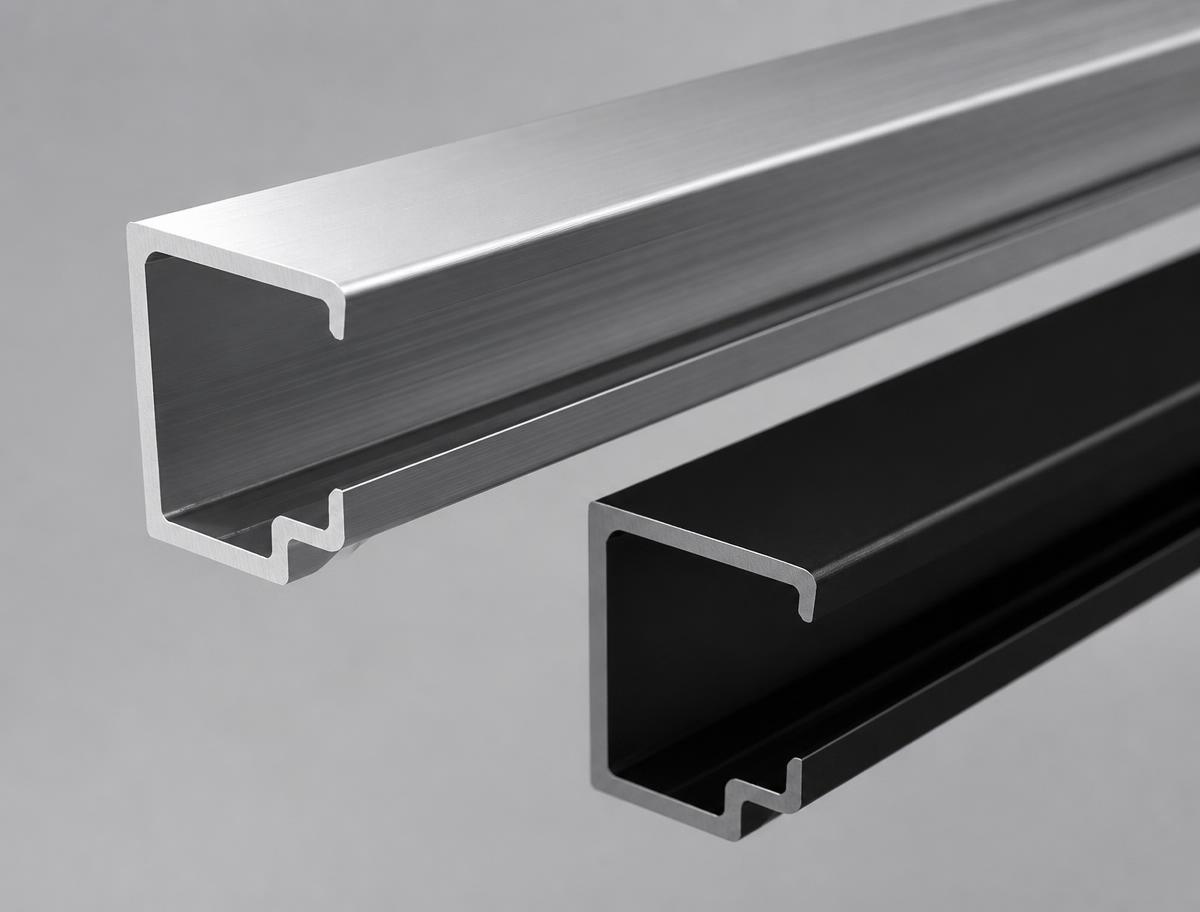
Three common ways to open a cabinet, and how they differ in the build.
| G profile handle | Gola profile | Bar or knob handle | |
|---|---|---|---|
| Fixed to | Top edge of the shutter or drawer front | The carcass, in a recessed channel | Face of the shutter, with screws |
| Look | Slim continuous groove | Shadow-line recess, almost invisible | Visible handle on every front |
| Carcass planning | Not needed | Needed at design stage | Not needed |
| Edge protection | Caps the raw board edge | Not its job | None |
| Best for | Handleless look on standard boards and wardrobes | Fully minimal kitchens | Conventional styling |
For the gola option, see the horizontal gola profile page.
Mirano's profile range is available in matte black, champagne gold, brushed or anodised silver and rose gold, with anodising and powder-coat options depending on the finish and application.
Anodising is generally specified where the profile sees heavy daily contact. It forms a harder, more scratch-resistant surface layer than a sprayed powder coat, at a marginally higher cost. Discuss the trade-off with your Mirano specification contact for working kitchens and everyday drawers.
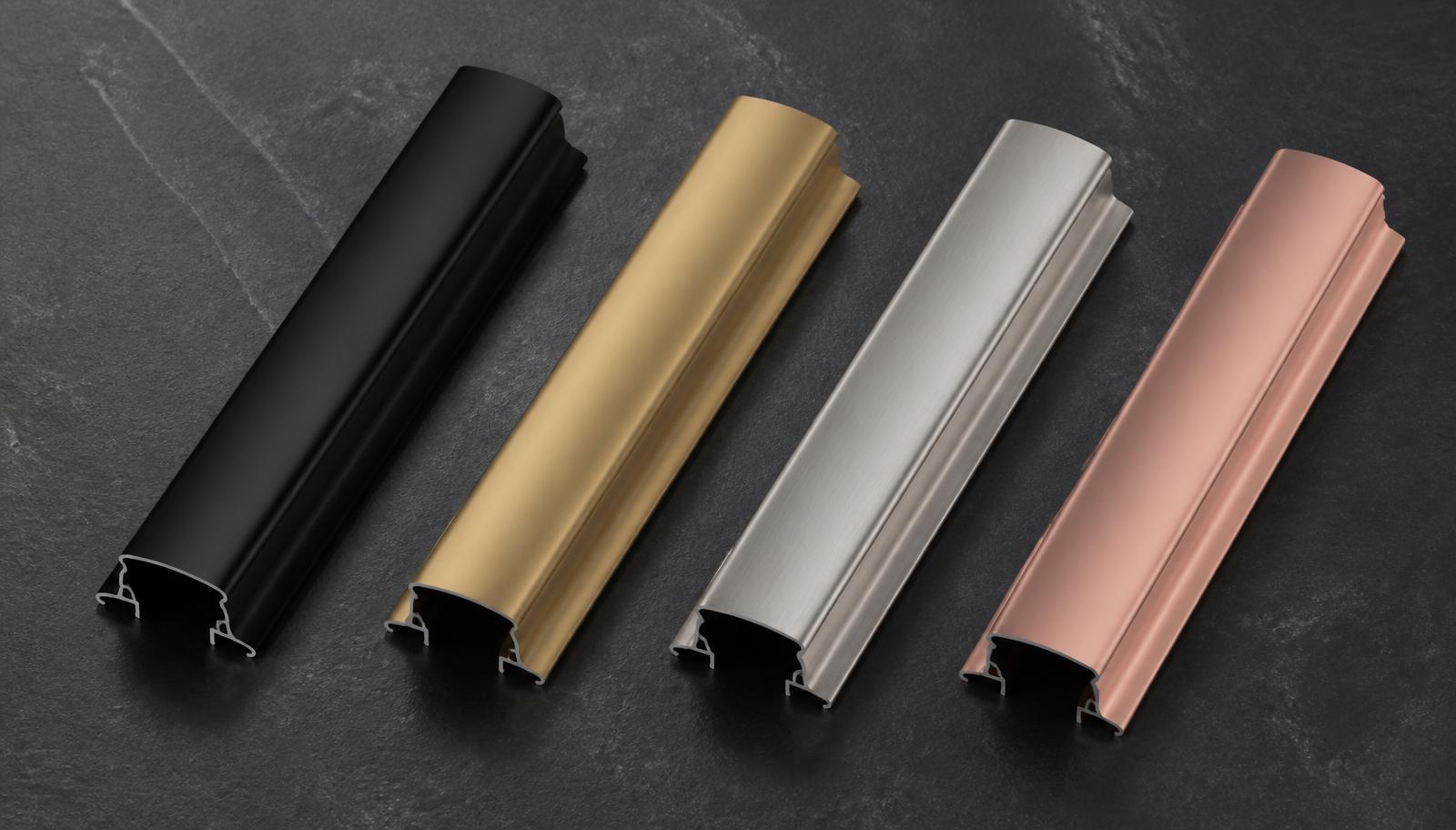
The points below decide whether a profile performs on a real project, beyond how a sample looks on a board.
| Factor | What to check |
|---|---|
| Board thickness | Most profile handles are engineered for 16 mm to 19 mm shutter boards. Heavier tall-unit or wardrobe shutters may need a 25 mm-compatible profile. |
| Length and joinery | Profiles are supplied in standard extrusion lengths and cut or mitred to size. Clean 45° corner joints depend on the connector as much as the profile. |
| Finish durability | Specify anodised finishes where contact is frequent, such as daily-use kitchen drawers. |
| Batch consistency | For project and OEM orders, extrusion-to-extrusion colour and tolerance matter more than one sample. Ask for batch documentation. |
| Lead time | Bulk and OEM orders should be planned against production and dispatch lead times, not retail stock. |
Dimensions and standard lengths for individual sections are available in the datasheet. Request them through the quote form.
A general sequence for OEM and site teams. Follow the fitting guidance supplied with the datasheet for the exact fixing method.
Confirm shutter board thickness against the profile's compatible range before cutting lengths.
Cut each profile to the shutter width. For corner joints, cut clean 45° mitres and use matching connectors.
Fix the profile along the top edge of the shutter or drawer front at a consistent position across the run.
Fit end caps, then check that every front opens easily and the groove lines up from unit to unit.
Most problems come from specification, not the profile itself.
A profile made for 16 mm to 19 mm boards will not seat properly on a heavier shutter. Check before ordering.
A poor connector or an uneven mitre shows as a gap. Specify matching connectors and test one corner first.
Everyday drawers wear a sprayed finish faster. Specify anodised where hands touch the profile daily.
Colour can differ slightly between production runs. Order a whole kitchen or wardrobe run together.
Kitchens are the largest use, but the same profile works across furniture.
| Application | What to watch |
|---|---|
| Kitchen base units and drawer fronts | Use an anodised finish for daily hand contact. |
| Kitchen wall and tall units | Keep the profile finish and orientation consistent along the run. |
| Wardrobe shutters and sliding doors | A handleless edge keeps a large surface uninterrupted. See wardrobe accessories. |
| Office and commercial furniture | A slim, snag-free edge is a practical need on counters, display units and storage. |
Request samples, finish options and project pricing for Mirano's G profile handles. We respond within one business day.